
What to Expect in a Rider Physiotherapy Assessment
Riders often invest significant time and resources into improving their horse’s training, strength and performance. But the rider is a key part of the system. Subtle limitations in mobility, strength or coordination can influence how clearly aids are delivered and how efficiently the horse is able to move beneath the rider.
A rider physiotherapy assessment looks at how the rider’s body functions both in and out of the saddle, identifying areas that may be limiting performance, symmetry or control. The goal is not simply to “correct posture”, but to improve the rider’s physical capacity so communication with the horse becomes clearer and more consistent.
Below is what typically happens during a rider physiotherapy session.
1. Assessment Begins in the Saddle
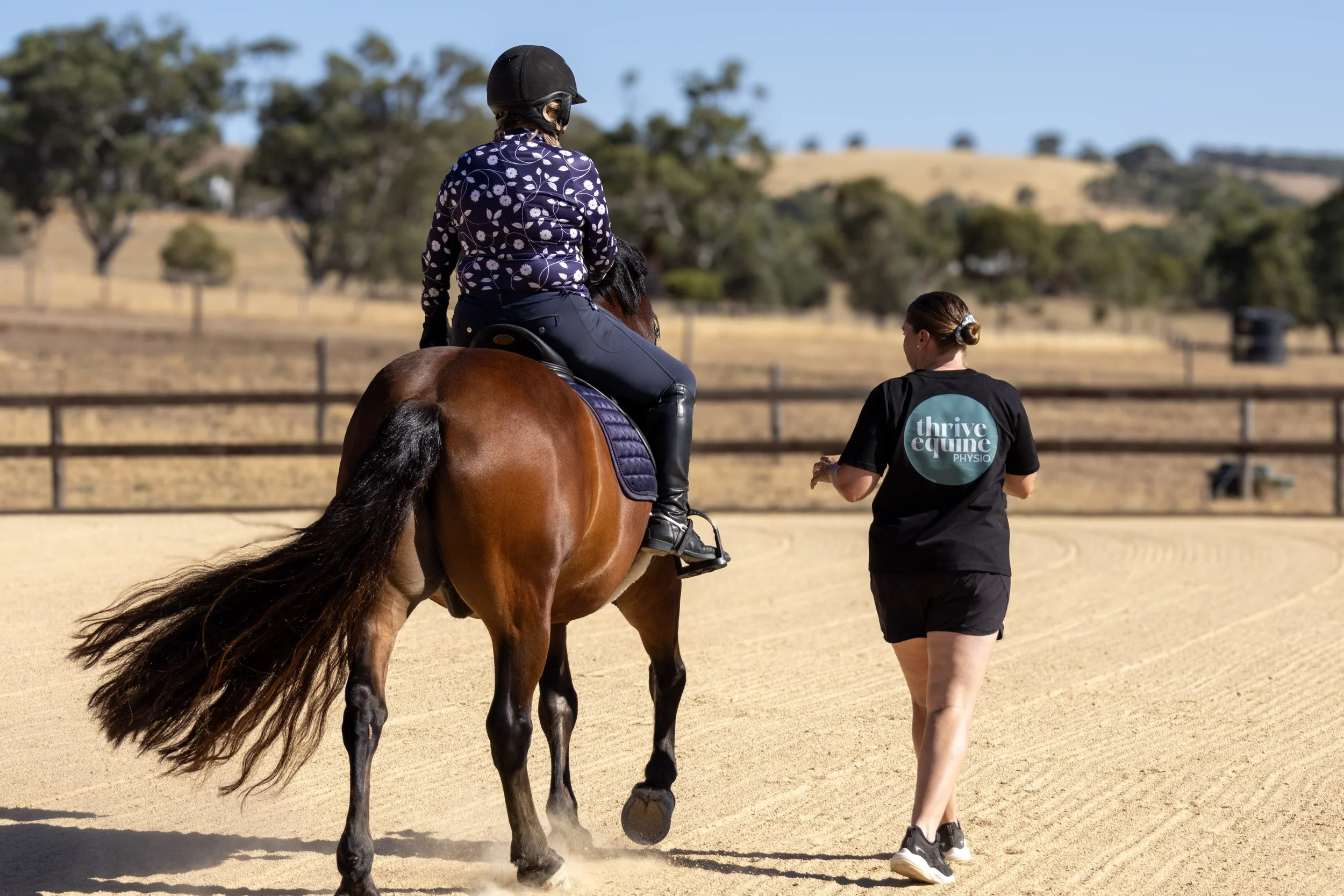
A rider physiotherapy assessment starts with observing the rider on the horse.
This allows the physiotherapist to see how the rider moves in the environment that matters most. During this stage we assess:
How the rider sits and stabilises in the saddle
How aids are applied
How the pelvis and trunk move with the horse
Symmetry between the left and right side
Efficiency of movement during transitions or lateral work
Often small differences become visible here, such as collapsing to one side, bracing through the trunk or difficulty maintaining symmetry between reins.
This stage is not about criticising riding style. It is about identifying where the rider’s body may be limiting efficiency or clarity of communication with the horse.
In some cases, simple on-horse exercises or cues may be introduced during the warm-up to help riders feel changes immediately.
2. Off-Horse Physical Assessment
After observing the rider in the saddle, the rider steps off the horse for a more detailed physical assessment.
This allows us to identify why certain patterns are occurring.
Areas commonly assessed include:
Hip mobility
Thoracic spine movement
Lumbopelvic control
Trunk strength
Single-leg stability
Balance and coordination
One of the key concepts we assess is motor control.
Motor control refers to how well the body coordinates and controls movement. A rider may have adequate strength or flexibility, but still struggle to control how different parts of the body work together. When motor control is limited, riders may find it difficult to stay centred, apply aids evenly or maintain stability while the horse moves beneath them.
Identifying these factors allows us to address the underlying cause rather than simply trying to “correct position”.
3. Treatment During the Session
Treatment is usually incorporated into the same session.
Depending on what is identified during the assessment, treatment may include:
Manual therapy
Mobility work
Targeted strengthening or activation exercises
Motor control training
Pilates-based exercises
Dry needling where appropriate
The goal is to improve the rider’s ability to move efficiently and maintain control while riding.
4. Returning to the Saddle
In many cases, riders return to the saddle during the session to reassess changes.
This helps riders immediately feel how improved mobility or control can influence their position and aids. Small adjustments often translate directly to improved communication with the horse.
5. Individualised Exercise Program
At the end of the session, riders leave with a structured exercise program designed specifically for them.
Exercises may include:
Off-horse mobility work
Strength and control exercises
Pilates-based exercises
Reformer Pilates
Gym-based strengthening
On-horse warm-up exercises
Programs are tailored to the rider’s goals and the equipment available to them.
Who Can Benefit From a Rider Physiotherapy Assessment?
Rider physiotherapy can be helpful for a range of situations, including:
Riders returning to riding after injury
Riders wanting to improve symmetry and stability in the saddle
Riders working to improve performance or consistency between reins
Riders who feel something “is not quite right” but cannot identify why
Often riders have been working on the same correction for months without progress. In these cases, assessing the rider’s physical capacity can provide valuable insight.
Supporting Both Horse and Rider
The horse and rider function as a system. Improving the rider’s mobility, strength and coordination often improves the clarity of communication between horse and rider.
For many combinations, addressing the rider’s biomechanics can help unlock improvements in straightness, consistency and overall performance.
Ready to Learn More?
Rider physiotherapy assessments evaluate how the rider moves in the saddle, identify physical limitations that may be influencing performance and provide a structured plan to address them.
Appointments can be arranged via the contact form on the website.